
Megan Kunze, associate director of the UO’s Center on Brain Injury Research & Training, is an expert on applied behavioral analysis, a research-based therapy proven effective in improving the quality of care for children with autism.
After being named a Fulbright Specialist last fall, Kunze was able to use her knowledge to improve the care delivered by teachers and therapists at a non-profit school supporting children with autism in Baku, the capital of Azerbaijan.

Kunze shared her expertise in workshops with teachers, intervention sessions with students, and parent consultations to provide strategies for modifying problem behavior and improving learning opportunities.
“It’s one of those very affirming things,” said Kunze, an assistant research professor in the departments of Psychology and Special Education with over 30 years of experience in the field of education.
To travel so far, and to work with people she now considers friends, collaborating toward a common goal, was a meaningful experience.
“I like to think I’m making a bit of a difference,” she said.
Kunze was named a Fulbright Specialist last October by the U.S. State Department and the Fulbright Foreign Scholarship Board. About 400 U.S. citizens are selected annually for the Fulbright Specialist Program, based on academic and professional achievement, leadership, and potential to foster long-term international cooperation.
Global organizations that need an expert to consult on an issue can make a request through the Fulbright program. Then scholars apply to work on the project.
“I am very interested in international work, and I do some other international consulting and this is in my wheelhouse,” Kunze said.
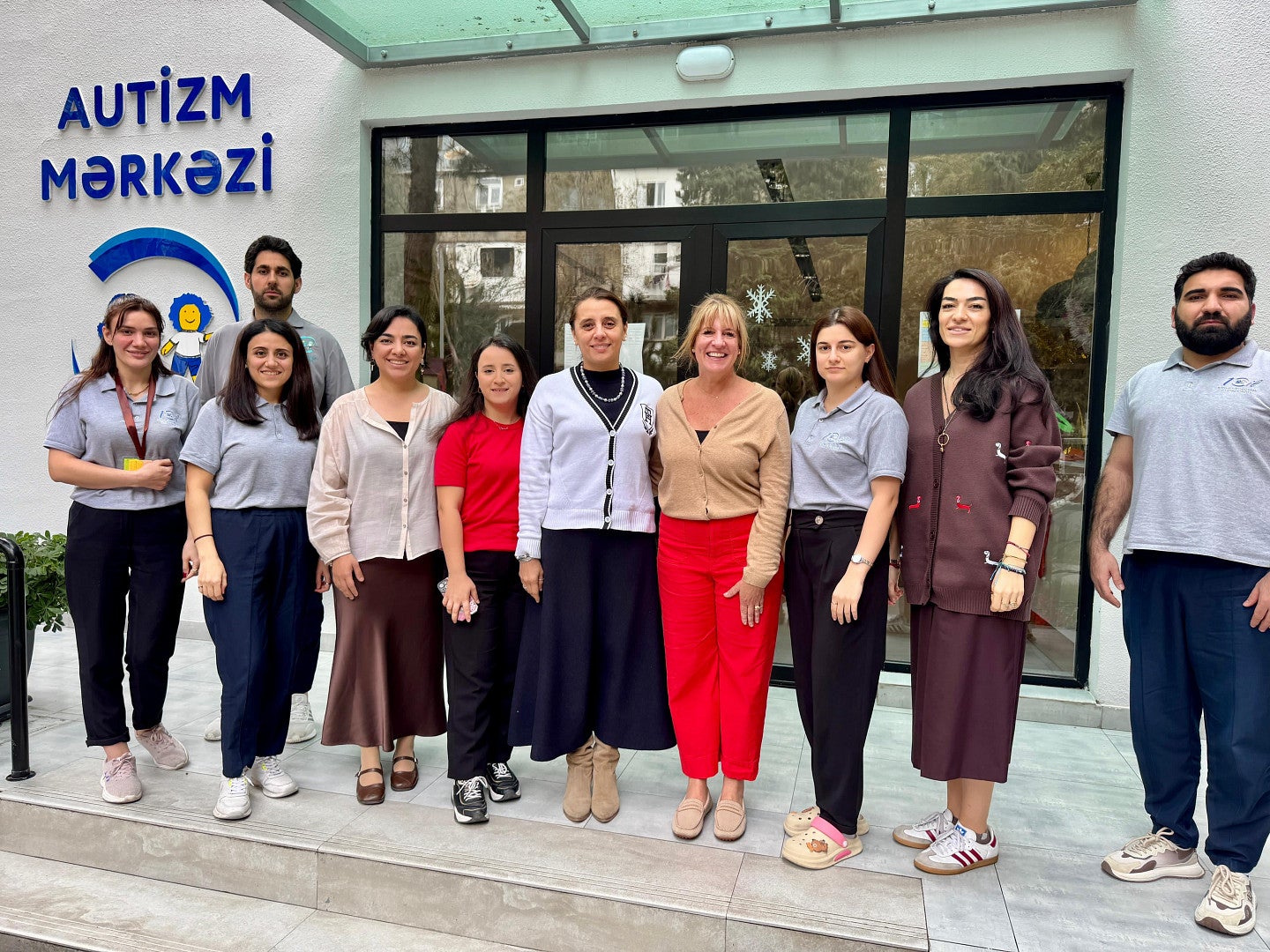
Kunze flew to Azerbaijan at the end of November and was there about two weeks to work with the staff at Together and Healthy Public Union. The nonprofit was founded about 10 years ago by the parents of an autistic child to provide an educational setting for him and other children. Autistic children who are not independent and who cannot verbally communicate are not permitted to attend public schools in Azerbaijan, Kunze said.

The government provides the group with assistance, including a three-story building with kitchens, multiple classrooms, sensory rooms, and exercise equipment. A highlight of this program is its employment initiative for autistic adults. Supported by the Azerbaijan government, the Union operates two cafés where autistic bakers prepare fresh pastries and autistic baristas craft the coffee. Through the school’s life‑skills curriculum, older students begin by learning to follow recipes and eventually earn a paycheck for their work at one of these inclusive cafés.
While consulting at the center, Kunze gave trainings every day to the staff, highlighting strategies of applied behavioral analysis. She would review the educational plans of about 10 students each day, observe each student, provide feedback, and suggest behavioral strategies. She also guest lectured at Baki Slavyan Universiteti to their faculty and students in the education department.
The teachers were very passionate about their work and had strong book knowledge about how to care for students with autism, but they sometimes resorted to old-school, punitive style of teaching, she said. What they were lacking was the ability to individualize their clinical skill set and apply a compassionate, child‑centered approach to working with their students.
“It was a bit of a paradigm shift for the teachers and a bit of a dance for me, to not make everyone dislike me,” she said.
She worked to change teachers’ perspectives and teach them about self-determination and to listen to the “voice” of each child. She offered them a quote from Maya Angelou: “Do the best you can until you know better. Then when you know better, do better.”
Nigar Izmayilova, public health liaison at the center, said Kunze’s visit helped staff members bridge the gap between theory and real clinical decision-making.
“It was inspiring to see how small but informed adjustments could significantly improve outcomes for children and reduce stress for both therapists and families,” she said.
Kunze also helped the staff re-assess and review the motivational methods they were using with children.
“We realized that some of the items we considered motivators were not actually motivating for certain children,” Izmayilova said.
After staff members adjusted their approach, “we observed noticeable reductions in challenging behaviors and improved engagement during sessions,” she said.
“She helped our team understand how to translate theory into real-time clinical judgment – how to analyze behavior patterns during sessions, when to modify an intervention, and how to individualize approaches rather than strictly follow protocols,” she said. “Watching her clinical reasoning process was as valuable as the formal training she provided.
“For the staff, this was a powerful learning moment because it demonstrated how precise clinical analysis can change outcomes without increasing intervention intensity.”
Kunze worked with one 10-year-old girl who would throw tantrums for up six hours a day. Her disheartened teacher asked Kunze if she ever felt like it was time to give up trying because you can’t make a difference.
“I said, ‘Of course, but I never stopped trying,’” she said. “Success looks different for everyone. Her success is coming, and it will look different, but it’s success all the same.”
Kunze checked in with the teachers recently and learned that the girl’s tantrums have decreased significantly using strategies suggested by Kunze. Her teachers adjusted her schedule, created space for her to self-regulate, and helped give her a voice to express her needs. Kunze continues to work with Together and Healthy Public Union in bi-weekly consultation meetings with school staff and families. She plans to return to Baku next year.
“It’s a lot of work, and it’s a lot of time,” she said, “but it’s so well worth it.”
-Tim Christie, Office of the Provost